
 login
login who are we?
 contact us
 qosheapp



How Much Water Does Generating AI Images Use?


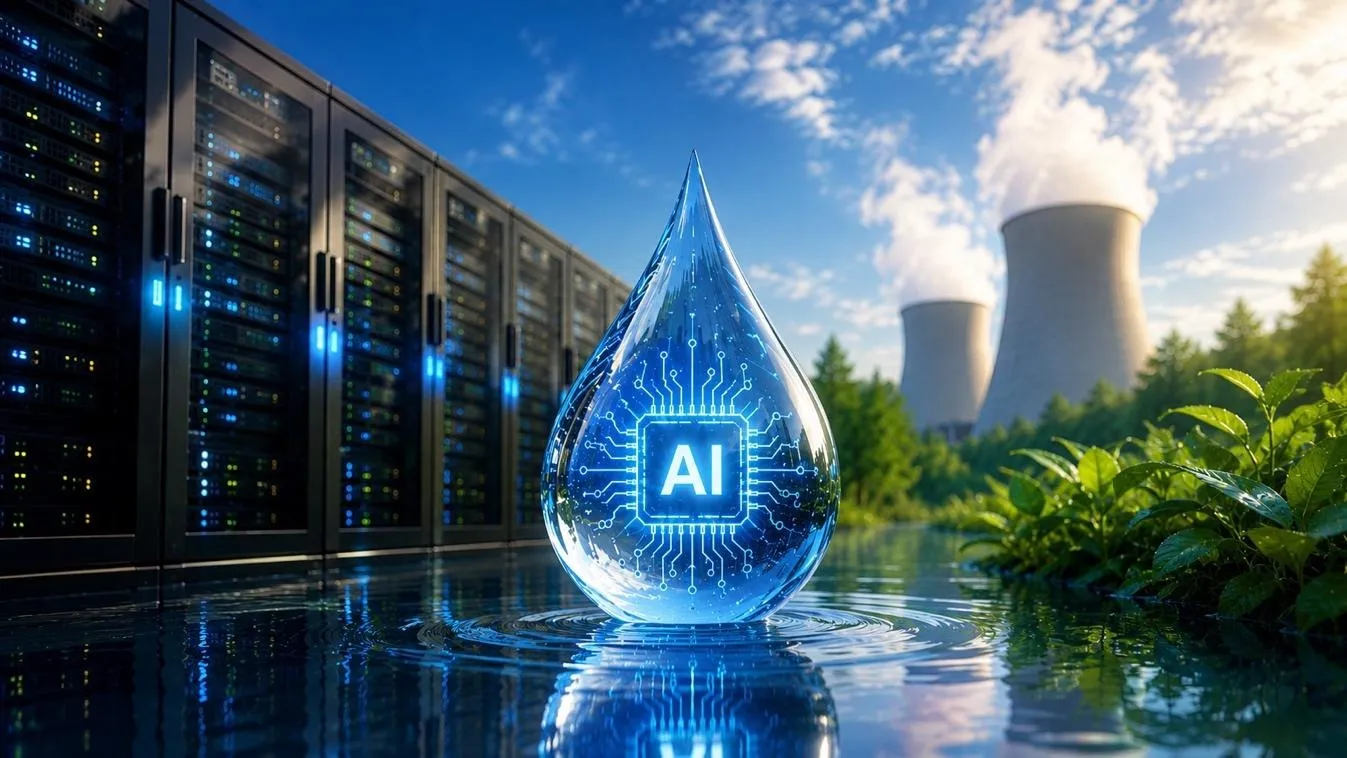
Artificial intelligence has made it easier than ever to create realistic artwork, concept designs, marketing graphics, and social media images in just a few seconds. Whether you're using AI for work, creative projects, or entertainment, every generated image relies on powerful servers working behind the scenes.
As AI adoption grows, so do questions about its environmental impact. Most people have heard discussions about AI's electricity consumption, but water use is becoming an equally important topic. Data centers that power AI models require cooling systems to prevent servers from overheating, and many of those systems depend on water. Water is also used indirectly to produce the electricity that keeps those facilities running.
So, how much water does generating an AI image use? The honest answer is that there isn't one simple number. The amount varies depending on the AI model, the hardware running it, the location of the data center, the cooling technology being used, and even the local electricity grid. While researchers have begun estimating AI's overall water footprint, calculating the water cost of a single image remains far more complicated than many headlines suggest.
Why AI Image Generation Uses Water
When you generate an AI image, your computer is not doing most of the work. Instead, your prompt is sent to remote servers equipped with high-performance GPUs designed to handle massive amounts of computation.
Those processors generate significant heat while creating images. If that heat is not removed efficiently, the hardware can slow down or become damaged. To keep temperatures under control, many data centers rely on cooling systems that use water either directly through cooling towers or indirectly as part of electricity production.
The water involved is often invisible to users. You never see it, and you don't pay for it separately, but it is still part of the infrastructure that makes cloud-based AI possible. Researchers describe this as both direct water consumption through cooling and indirect water consumption through electricity generation.
There Is No Universal Water Cost Per Image
One of the biggest misconceptions online is that every AI-generated image uses a fixed amount of water. No reputable study supports a single universal number.
The total water footprint depends on several variables, including:
-
The AI model being used
-
The graphics hardware processing the request
-
Image resolution
-
Number of inference steps
-
Data center cooling technology
-
Local climate
-
Electricity source
-
Overall server utilization
Because these variables differ between providers, two AI image generators can have dramatically different environmental footprints even when producing similar images.
Researchers continue refining methods for estimating AI's resource usage, but they generally agree that broad averages should be interpreted carefully rather than treated as precise measurements.
Model Efficiency Matters More Than Most People Realize
Not every AI image generator is equally efficient.
Recent research comparing seventeen modern image generation models found enormous differences in energy consumption. Some models required dozens of times more energy than others to generate comparable images, demonstrating that efficiency depends heavily on the underlying architecture rather than simply image quality.
Since energy use and water consumption are closely connected, more efficient models can also reduce the overall environmental impact. Advances in GPU design, optimized inference engines, and improved model architectures continue to lower the resources required for each generation.
This means the environmental footprint of AI images is likely to improve over time as hardware and software become more efficient.
Does Image Resolution Increase Water Use?
Generating larger and more detailed images requires additional computation. Higher resolutions often require more processing time, additional memory, and more GPU resources.
However, the relationship is not perfectly linear. Some AI models scale efficiently as resolution increases, while others require substantially more computation. Recent academic work found that doubling image resolution produced energy increases ranging from approximately 1.3 to nearly 5 times depending on the model being tested.
Other factors can also increase resource usage. Running multiple generations to find the perfect image, performing inpainting or out painting, upscaling outputs, or creating long batches of variations all require additional compute time.
For creators who regularly generate hundreds of images, these small increases can add up over time.
Different AI Image Generators Have Different Resource Demands
The AI image generation market has become increasingly specialized. Some platforms focus on realistic photography, while others emphasize anime artwork, logo creation, marketing graphics, architecture, product mockups, or digital illustration. There are also niche platforms designed for adult and NSFW content with fewer prompt restrictions than mainstream services. Because these tools differ in their underlying models, features, and intended audiences, comparing a curated list of AI image generators can help creators choose the platform that best matches their needs instead of relying solely on the largest or most popular service.
While users often compare image quality and pricing, efficiency is becoming another factor worth considering. As AI adoption continues to grow, improvements in model optimization and infrastructure may become just as important as artistic capabilities.
How Data Centers Are Reducing Their Water Footprint
As concerns about AI's environmental impact continue to grow, many technology companies are investing in more efficient data center infrastructure. Cooling systems have become significantly more advanced over the past decade, with operators exploring methods that reduce both electricity consumption and water usage.
Some facilities use outside air when weather conditions allow, while others recycle cooling water instead of continuously drawing fresh supplies. Liquid cooling technologies are also becoming more common for high-performance AI hardware because they can remove heat more efficiently than traditional air-cooling systems.
Location also plays an important role. A data center operating in a cooler climate may require less water for cooling than one located in a hotter, drier region. Likewise, facilities powered by renewable energy may reduce the indirect water consumed through electricity generation, although the exact impact depends on the local energy mix.
These improvements won't eliminate AI's environmental footprint, but they demonstrate that infrastructure continues to evolve alongside the rapid growth of artificial intelligence.
Should Creators Be Concerned?
For the average person generating a handful of AI images each week, the individual environmental impact is relatively small. The larger concern comes from scale.
Millions of users generate AI images every day. Businesses create marketing materials, developers test models, designers experiment with concepts, and creators produce artwork in large batches. Collectively, those workloads require enormous computing resources across data centers around the world.
That does not necessarily mean people should stop using AI image generators. Instead, it highlights the importance of building more efficient models and encouraging responsible infrastructure development.
The conversation is like discussions about cloud computing, video streaming, or cryptocurrency. Digital services provide value, but they also consume physical resources that often remain hidden from users.
Ways to Reduce the Environmental Impact of AI Image Generation
Individual users may not control how a data center is designed, but they can reduce unnecessary computing by using AI tools more efficiently.
Writing clearer prompts before generating images often reduces the number of failed attempts. Instead of producing dozens of nearly identical variations, spending a little more time refining the prompt can improve the first result.
Creators can also avoid generating images they never intend to use. Large batches may seem convenient, but they increase computational demand without always providing additional value.
When editing an existing image, features such as inpainting or localized edits may be more efficient than regenerating an entirely new image from scratch. Likewise, upscaling only final images instead of every draft can reduce unnecessary processing.
The Future of Sustainable AI
Researchers and technology companies are paying closer attention to AI's environmental footprint than they were only a few years ago. New generations of GPUs continue to improve performance while reducing energy consumption per operation, and AI developers are finding ways to build models that require less computation during inference.
At the same time, data center operators are investing in more efficient cooling systems, renewable energy projects, and infrastructure designed to reduce water consumption where possible.
Transparency is also improving. More organizations are publishing sustainability reports and discussing the environmental costs associated with cloud computing and AI workloads. As reporting standards become more consistent, users will likely gain a clearer understanding of how different AI services compare from an environmental perspective.
While no technology is completely without environmental impact, ongoing improvements suggest that future AI image generation could become significantly more resource-efficient than it is today.
Final Thoughts
Generating AI images does use water, but not in the direct way many people imagine. The water footprint comes primarily from the data centers and energy infrastructure that power modern AI systems, and the amount varies depending on the model, hardware, cooling technology, geographic location, and electricity source.
Because there is no single, universally accepted water cost for every AI-generated image, it is important to be cautious of headlines that present one fixed number. The best available research shows that AI's water consumption is highly variable and continues to change as technology improves.
As image generation becomes more mainstream, efficiency will likely become another area of competition alongside image quality, speed, and price. Better models, improved hardware, and smarter data center design can help reduce the environmental impact while allowing creators to continue benefiting from AI-powered tools.
For users, the most practical approach is simple: use AI intentionally, generate only what you need, and choose platforms that continue investing in efficient and responsible infrastructure. Small improvements across millions of users can have a meaningful impact over time.
© qolumnist
 visit website