
 login
 who are we?
 contact us
 qosheapp




How AI-Powered CRM Improves Lead Management in Malaysia


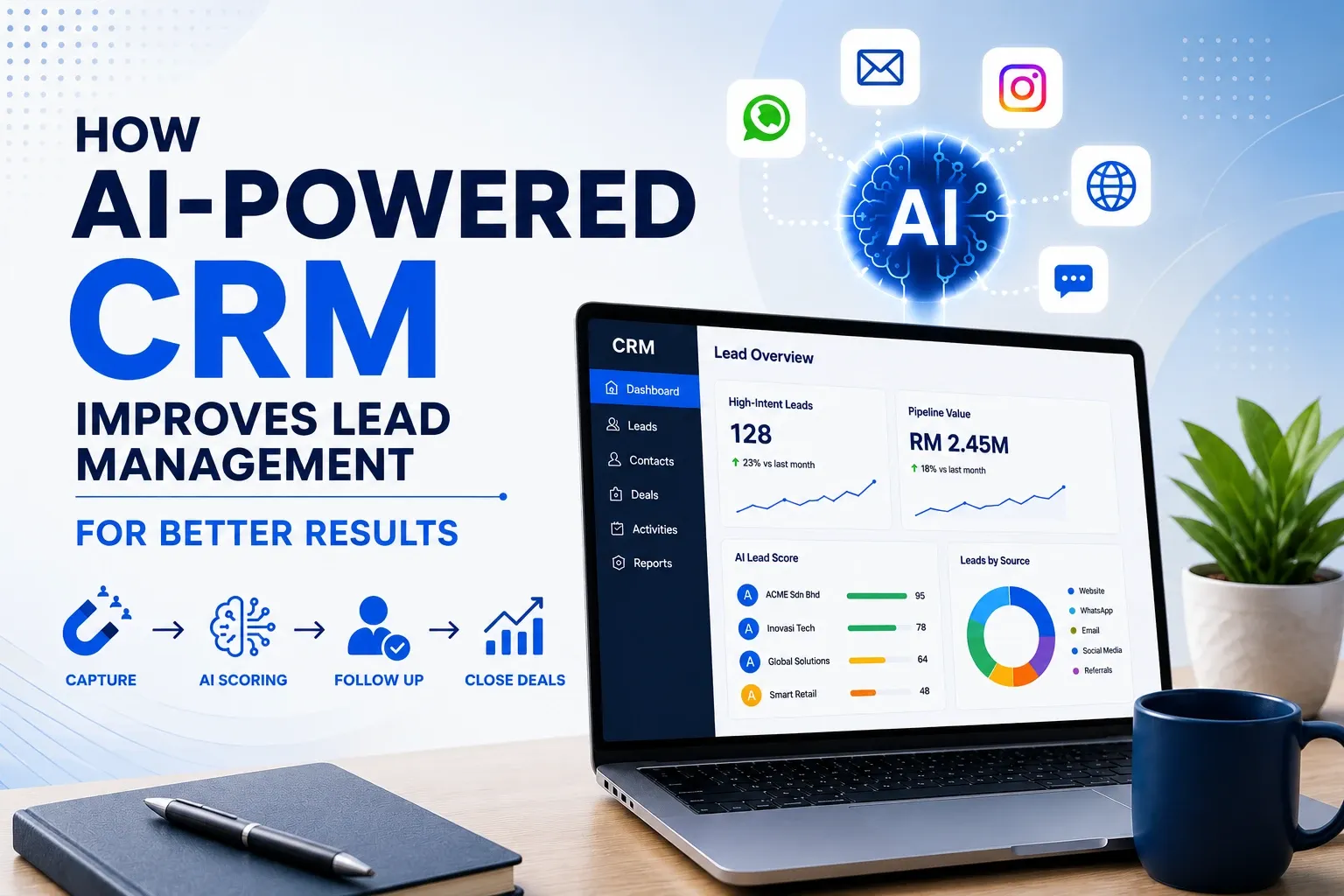
Malaysian businesses now receive customer inquiries through WhatsApp, email, social media, online marketplaces, website forms, and direct referrals. While these channels create more opportunities, they also make customer information increasingly difficult to manage.
When sales representatives store information in spreadsheets, personal devices, or separate applications, important inquiries can be overlooked. Managers may also struggle to identify high-potential prospects and understand the actual condition of their sales pipeline.
AI-powered customer relationship management provides a more structured approach. Instead of functioning only as a database, an AI CRM analyses sales activities, identifies buying signals, recommends priorities, and automates routine follow-ups.
Why AI CRM Matters
A conventional CRM records customer details, conversations, opportunities, and sales stages. An AI-powered CRM goes further by using machine learning, predictive analytics, and automation to interpret this information.
For example, the system can identify prospects who frequently visit product pages, respond to messages, request quotations, or demonstrate other signs of purchasing intent. Sales representatives can then prioritize these opportunities instead of reviewing every record manually.
However, AI can only generate useful recommendations when the underlying information is accurate. Businesses first need reliable CRM software for managing customer relationships that centralizes customer profiles, communication histories, sales activities, and transaction records.
This centralized approach is particularly relevant in Malaysia, where customers may communicate through different platforms and languages. A shared record helps sales, marketing, and customer service teams maintain consistent communication across every channel.
Five Ways AI Improves Lead Management
1. Automating lead capture
AI CRM can collect inquiries from connected websites, email campaigns, digital advertisements, and other sales channels. This reduces manual data entry and prevents customer information from remaining inside an employee’s personal inbox or mobile phone.
2. Keeping customer data accurate
The system can identify duplicate records based on telephone numbers, email addresses, or company information. Cleaner data prevents multiple representatives from contacting the same prospect without coordination.
3. Prioritising high-intent prospects
AI lead scoring evaluates customer behavior, company profile, engagement frequency, requested products, and pipeline activity. It then ranks leads according to their estimated likelihood of conversion.
High-intent prospects can receive immediate attention, while early-stage leads remain in nurturing workflows until they show stronger buying signals.
4. Assigning leads more effectively
Enquiries can be routed according to territory, product expertise, language preference, workload, or previous performance. A complex B2B prospect, for example, can be assigned to a representative with relevant industry experience instead of being distributed randomly.
5. Improving follow-ups and forecasting
Automated reminders notify employees when a quotation receives no response or an opportunity remains inactive. AI can also analyze historical conversion patterns and current deal activities to estimate which opportunities are genuinely likely to close.
What Malaysian Businesses Should Consider
Technology works best when supported by clear sales lead management strategies. Businesses should establish consistent rules for:
- How new enquiries enter the sales pipeline.
- What customer information must be collected.
- When a lead becomes qualified.
- Who owns each pipeline stage.
- How quickly representatives must respond.
- When inactive opportunities should be closed.
Without these rules, automation may accelerate an inconsistent process rather than improve it.
Businesses should initially focus on one practical use case, such as automated lead capture, lead scoring, or follow-up reminders. Once the process produces reliable results, AI can be extended into forecasting, customer segmentation, retention analysis, and personalized recommendations.
When evaluating an AI CRM, Malaysian businesses should prioritize capabilities such as:
Businesses should choose a CRM that can connect with the communication channels their customers actually use, such as WhatsApp, email, websites, social media, and online marketplaces. This helps prevent inquiries from becoming isolated across different platforms or remaining inside individual employees' inboxes and mobile devices. A centralized record also allows sales and customer service teams to see previous interactions before contacting a prospect, reducing duplicated or inconsistent communication. The article identifies fragmented communication as one of the reasons customer information becomes difficult to manage.
Every business has different sales stages and definitions of a qualified lead. A configurable CRM allows businesses to determine how inquiries move from initial contact to qualification, quotation, negotiation, and closing. This is important because AI automation depends on having consistent rules. Without clearly defined qualification criteria and pipeline ownership, automation may simply accelerate an inconsistent sales process rather than improve it.
Mobile access is particularly useful when sales representatives meet customers outside the office, attend events, visit business premises, or manage leads while travelling. Representatives can update lead information, record activities, check customer history, and respond to opportunities without waiting to return to a desktop computer. This helps keep the CRM record current rather than leaving important information on personal devices or in separate notes.
A CRM should be able to automatically route new inquiries to the appropriate representative based on factors such as territory, product expertise, language preference, or workload. This reduces the risk of leads being left unassigned or handled by the wrong salesperson. The article also highlights automated reminders for inactive opportunities and unanswered quotations, helping representatives follow up at the appropriate time rather than relying entirely on memory.
Sales managers need current visibility into how many leads are entering the pipeline, where opportunities are progressing or becoming inactive, and which opportunities have stronger conversion potential. AI CRM systems can analyze customer behavior and pipeline activity to identify high-intent prospects and support forecasting. This allows managers to make decisions based on current pipeline conditions rather than relying on manually consolidated spreadsheets or delayed reports.
CRM should not operate as an isolated database if the sales process depends on information from other business functions. Connecting customer and lead information with quotations, inventory, accounting, and sales orders can give sales representatives a more complete view of an opportunity. For example, a salesperson may need to know whether a requested product is available, whether a quotation has been issued, or whether an order has already been processed. Integrating these processes can reduce duplicate data entry and help teams work from consistent transaction information.
Customer data should not automatically be accessible to every employee. Role-based permissions allow businesses to control which customer information different employees can view, edit, export, or manage. Activity tracking also creates greater visibility into who has interacted with a lead and what actions have been taken. This is particularly important because customer information needs to be handled responsibly and in accordance with Malaysia's Personal Data Protection Act 2010. The article specifically identifies role-based permissions, controlled data exports, secure integrations, and regular data reviews as relevant safeguards.
Businesses operating across multiple branches, sales territories, or regions need a CRM that can distinguish between different teams and customer ownership. This makes it easier to assign leads to the appropriate representative, monitor performance by territory, and prevent multiple salespeople from contacting the same customer without coordination. It also becomes increasingly important as a business grows, because a CRM should support the organization's sales structure rather than require teams to maintain separate customer databases.
Customer information must also be handled in accordance with Malaysia’s Personal Data Protection Act 2010. Role-based permissions, controlled data exports, secure integrations, and regular data reviews help ensure information is only accessed by authorized employees for legitimate business purposes.
AI-powered CRM ultimately helps Malaysian businesses move from reactive administration towards proactive sales management. With accurate data, defined workflows, and responsible governance, companies can respond to prospects faster, maintain stronger customer relationships, and build a more predictable sales pipeline.
© qolumnist
 visit website